AI: Bill Gates Warns It 'Makes Nuclear Weapons Look Like Nothing'
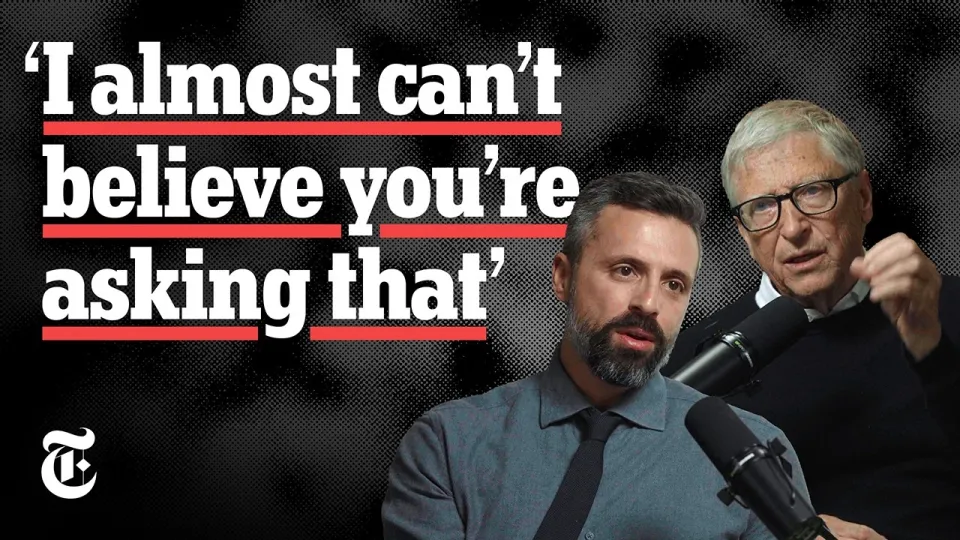
Video: Bill Gates: A.I. ‘Makes Nuclear Weapons Look Like Nothing’ | The Ezra Klein Show
Need articles like this for your video? They help promote it on YouTube and Google — order them in the Telegram bot @sat_sit_bot. The bot writes and publishes the articles itself (with your YouTube video embedded) on popular topical websites (no ads). Free trial — 50 articles.
· based on the channel The Ezra Klein Show
Key takeaways
- Gates calls AI the most dangerous technology humanity has approached and says it makes nuclear weapons 'look like nothing.'
- He rejects industry self-regulation as 'insane' and wants government-set thresholds for cyber and bio capabilities.
- Gates predicts catastrophic cyberattacks, bio-terrorism and mass job loss unless policy moves first.
- He frames AI-driven inequality as a new Gates Foundation priority, alongside roughly $200 billion in planned spending over two decades.
- The interview, published by The Ezra Klein Show, also covers the US–China race, taxing AI labor and 'human reserved' jobs.
AI, in Bill Gates's assessment, is the most dangerous technology humanity has ever approached — dangerous enough that it "makes nuclear weapons look like nothing." In a conversation with Ezra Klein published by The Ezra Klein Show, the Microsoft co-founder argues that catastrophic cyberattacks, bio-terrorism and mass job loss are plausible unless governments set hard limits on frontier models, and that the industry regulating itself is "insane." The full transcript and episode are available at the New York Times opinion page for the Ezra Klein podcast.
What Gates actually said about AI risk
Gates's position is not that AI is overhyped but that the alarm is understated. He told Klein he once viewed artificial intelligence as a useful but limited tool and has since revised that view sharply, describing the current moment as one where systems have crossed into capabilities he did not expect this soon. The comparison to nuclear weapons is his framing for scale, not a claim about the technology's mechanism: a nuclear arsenal is bounded by physics, fissile material and state control, while a frontier model is software that can be copied, fine-tuned and deployed by almost anyone with compute.
That asymmetry is the core of his argument. Nuclear risk is concentrated in a handful of governments. AI risk is distributed across every actor who can rent a GPU cluster, which is why Gates keeps returning to the question of speed: capability is improving faster than the institutions meant to supervise it. In the episode he repeatedly pushes back on the idea that the dangers are speculative, treating them instead as a scheduling problem — the question is not whether a bad outcome is possible but how many years remain before one becomes likely.
The two thresholds: cyber and bio
Gates singles out two capability thresholds that he believes should trigger mandatory government action rather than voluntary pledges. The first is cyber offense: a model that can autonomously find and exploit vulnerabilities in critical infrastructure — power grids, water systems, hospitals, financial clearing — changes the economics of attack from a specialist team to a script. The second is biological: a model that can meaningfully assist in the design or synthesis of pathogens. Both are areas where the gap between a demonstration and a mass-casualty event is short, and where the private sector has no natural incentive to slow down.
His proposed logic is threshold-based rather than blanket prohibition. Define measurable capability levels, require testing before a model crosses them, and make the results visible to regulators. The difficulty, which Klein presses him on, is that no one has agreed on what those thresholds are or who measures them, and labs have obvious reasons to define them narrowly.
Why self-regulation fails, in Gates's view
Gates's answer to industry self-governance is blunt: it is "insane" to expect companies to police themselves on risks that only materialize after deployment. His reasoning rests on incentives rather than character. A lab that pauses to run safety evaluations while a competitor ships loses market share, talent and compute contracts; the cost of caution is paid immediately, while the cost of a disaster is deferred and shared. That structure produces a race in which the responsible move is also the losing move, which is precisely the condition regulation exists to fix.
He is equally dismissive of liability as a substitute for rules. The image he returns to is a lawsuit arriving after a catastrophe that kills millions — a legal remedy that is meaningless at that scale. Klein's interview is notable for how visibly frustrated Gates becomes at this point, and for his willingness to say that many people in positions of authority are in denial about what is coming.
Jobs, inequality and the case for taxing AI labor
On employment, Gates expects disruption rather than immediate apocalypse, but he does not treat the transition as painless. He describes a labor market where AI absorbs routine cognitive work faster than new roles appear, with the burden falling hardest on entry-level workers and on developing economies that were counting on outsourcing and services for growth. His foundation has made steering AI toward equality — rather than letting it widen gaps — a stated priority, alongside plans to spend down roughly $200 billion over the next two decades.
He floats several policy ideas rather than a single program. One is taxing AI-driven labor or capital so that the productivity gains fund adjustment rather than concentrating at the firms that own the models. Another is the notion of "human reserved" jobs — roles where people deliberately remain in the loop for reasons of accountability or preference, from care work to certain public decisions. He also points to language tools as an underrated equalizer, giving communities access to education and services in their own languages, while acknowledging that the same tools can erode local media and trust.
The US–China race and the regulation question
Gates treats the competition with China as a reason for regulation, not an argument against it. If two economies are racing to deploy the most capable systems, the only way either can slow down without unilateral disadvantage is a shared framework — on testing, on reporting, on what counts as a prohibited capability. He is realistic about how hard that is and does not pretend a treaty is imminent, but he rejects the framing that safety and competitiveness trade off cleanly.
On children and education, his position is more granular. He supports age-based restrictions and design standards for AI products aimed at minors, and he argues that rich countries have already shown how technology deployed without pedagogy produces learning loss rather than gains. The political future of AI regulation, in his telling, depends on whether voters experience harm directly — a cyberattack on a grid, a hospital outage — before they experience the benefits broadly enough to demand guardrails.
Common questions listeners raised
Viewers of the episode reacted less to Gates's policy details than to his demeanor: many noted they had never seen him this agitated, and several said that if he is worried, they are worried. That reaction points to a real gap in the public conversation — the sense that the people building and funding these systems know something the rest of us do not, and that the reassurance on offer is thinner than the risk.
The most persistent doubts fall into three groups. First, whether regulation can survive contact with geopolitics, given that a slow-moving agency cannot audit a model it cannot inspect. Second, whether the job transition is a decade-long adjustment or a sudden shock, which determines whether retraining programs are adequate or irrelevant. Third, whether Gates's own history — a technologist who spent decades arguing that software would improve institutions — makes him an unlikely convert to precaution or a credible one. His answer in the episode is essentially that the evidence changed, so his position did.
Useful links
- Full transcript and episode page at The New York Times — the complete conversation and show notes.
- Book recommendations from Ezra Klein Show guests — the running list referenced at the end of each episode.
The bottom line
Gates's message is that AI risk is a governance problem arriving on a schedule, and that the institutions meant to handle it are moving at the wrong speed. The concrete asks are unglamorous: define cyber and bio capability thresholds, test before deployment, publish results, and stop pretending that liability or voluntary pledges will cover a mass-casualty failure. What makes the interview worth the hour is the contrast between Klein's pressing for specifics and Gates's insistence that the specifics are worse than the framing suggests. The Ezra Klein Show produced the conversation, and the transcript is the best place to check the claims against the argument. Read it at The New York Times and judge whether the alarm is overstated or overdue.
Source: Bill Gates: A.I. ‘Makes Nuclear Weapons Look Like Nothing’ | The Ezra Klein Show · Markdown version
Questions & answers
Why does Bill Gates compare AI to nuclear weapons?
He uses the comparison to describe scale, not mechanism. A nuclear arsenal is limited by physics and state control, while a frontier model is software that can be copied and deployed widely. In his view, that makes the worst-case outcomes harder to contain than nuclear proliferation.
What does Gates mean when he says self-regulation is 'insane'?
He argues that labs face immediate costs for caution and deferred, shared costs for failure, so voluntary safety pledges lose to competitive pressure. He wants government-set capability thresholds, pre-deployment testing and mandatory reporting instead of industry discretion.
Does Gates think AI will cause mass unemployment?
He expects significant disruption rather than instant collapse, with routine cognitive and entry-level work affected first and developing economies exposed through services and outsourcing. He proposes options such as taxing AI-driven labor and reserving some roles for humans.
What role does the Gates Foundation plan to play?
The foundation has made steering AI toward equality a priority and plans to spend down roughly $200 billion over two decades. Gates frames the goal as making sure the productivity gains do not concentrate only in the countries and companies that own the models.